
Quick guide
Is this article relevant to you?
What is this?
Tiebacks are not always available on constrained excavation sites. Learn how rakers, internal bracing, corner bracing, transfer walers, and cross-lot bracing can affect shoring design and construction sequencing.
Who is this best for?
Owners, developers, architects, general contractors, and shoring contractors working on constrained excavations where tiebacks may not be permitted or practical.
This is relevant if you:
- Cannot obtain a tieback agreement or need to stay within the property line.
- Have utilities, tunnels, basements, foundations, or other obstructions behind the shoring wall.
- Need to understand how alternate bracing will affect access, sequencing, pricing, or construction logistics.
Key takeaways
- Tiebacks depend on permission, geometry, utilities, subsurface conditions, and adjacent property constraints.
- Rakers and internal bracing can solve tieback restrictions but may reduce excavation access.
- Corner bracing and transfer walers can help avoid specific obstructions, but they require clear load paths.
- The earlier the bracing strategy is understood, the easier it is to price, sequence, and coordinate.
Tiebacks can be an efficient way to brace excavation support, but they are not always available. Property-line restrictions, easement issues, utilities, transit structures, adjacent basements, tunnels, and neighboring buildings can all limit where anchors can be drilled.
When that happens, the shoring design may need rakers, internal bracing, corner bracing, transfer walers, cross-lot bracing, short anchors, cantilever piles, or a combination of systems. The key question is not simply what replaces the tieback. It is how the alternate bracing approach changes excavation sequence, access, deck construction, equipment movement, foundation work, and risk.
What to send an engineer
- Plans, sketches, or existing drawings
- Geotechnical report or soils information
- Site photos, access limits, and adjacent constraints
- Timeline, bid deadline, or current field issue
Why tiebacks are not always available
Tiebacks extend beyond the shoring wall, so their feasibility depends on more than excavation depth. Neighbor agreements, property lines, easements, public right-of-way limits, utilities, tunnels, adjacent basements, and existing foundations can all create conflict zones.
Soil and groundwater conditions also matter. Anchor length, angle, load, corrosion protection, and testing requirements may make a tieback layout impractical even when access appears available on plan.
Common alternatives when anchors are limited
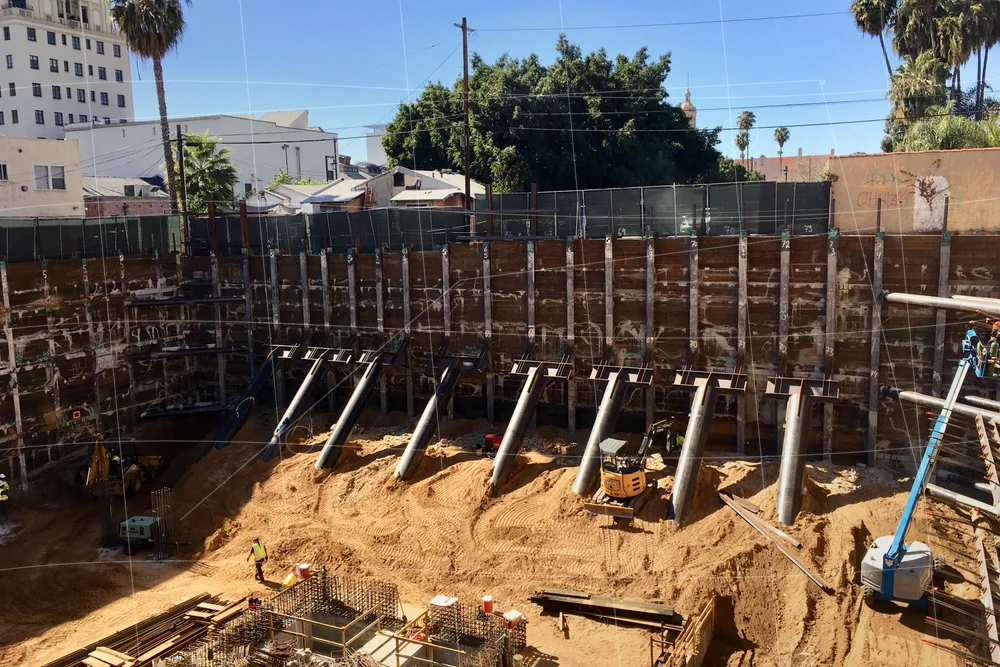
Rakers brace the shoring wall from inside the excavation, typically bearing against a temporary pad or other internal support. Internal bracing and cross-lot bracing can span across the excavation where geometry allows. Corner bracing can avoid specific conflict zones while still moving load through walers and compression members.
Transfer walers, short anchors, high-angle anchors, and cantilever soldier piles may also be part of the strategy. The right combination depends on excavation depth, wall movement limits, surcharge loads, foundation layout, access, sequencing, and geotechnical recommendations.
How alternatives affect construction
- Rakers and internal braces can reduce open excavation access and affect truck, crane, and equipment movement.
- Raker pads, temporary supports, and deck penetrations can change foundation and slab sequencing.
- Cross-lot bracing can solve property-line issues but may conflict with excavation equipment or permanent building work.
- Corner bracing and transfer walers need careful detailing so loads have a clear path back into the support system.
- Field changes may require retrofit walers, supplemental bracing, revised tieback assumptions, or additional review.
What to clarify early
Before a project team assumes a bracing strategy, clarify property-line conditions, neighbor and easement status, utility maps, potholing status, existing structure drawings, geotechnical recommendations, proposed excavation depth, basement levels, and contractor access assumptions.
These inputs help the shoring engineer compare feasible systems before the project loses time to pricing gaps, late conflicts, or redesign during excavation.
Project examples
See how these issues show up on real Cefali project profiles.
Shows internal bracing near Metro station structures and tieback-agreement limitations on a six-level excavation.
Private Development755 FigShows a deep, narrow excavation with heavy surcharges, underpinning, pedestrian bridge support, and internal bracing.
Private DevelopmentG-8Shows raker-braced soldier piles and a tied-back raker pad near historic buildings and an adjacent basement wall.
Sports and EntertainmentIntuit DomeShows cross-lot bracing where tieback agreements could not be secured at a large below-grade venue project.
Next Step
Send the basics before the project gets expensive.
If you have drawings, a geotechnical report, site photos, plan check comments, or a rough excavation or foundation question, Cefali & Associates can help identify the right structural engineering support.
Send project information