
Quick guide
Is this article relevant to you?
What is this?
Why Los Angeles hillside lots, slopes, retaining walls, and limited-access sites often require specialty foundation engineering.
Who is this best for?
Los Angeles owners, architects, developers, and contractors planning work on a slope, near a retaining wall, or on a site with limited construction access.
This is relevant if you:
- Are planning an addition, pool, retaining wall, driveway, or new structure on a hillside lot.
- See cracking, wall movement, drainage problems, or signs of slope movement.
- Need to understand how access, neighboring properties, or steep terrain may affect the foundation approach.
Key takeaways
- Hillside projects often involve slope stability, retaining wall, drainage, access, and adjacent property questions at the same time.
- Limited access can drive the foundation system as much as structural demand.
- Drainage and soil movement should be understood early, not treated as late details.
- Photos, survey, geotechnical information, and existing wall conditions are especially important for first review.
Los Angeles hillside projects can look simple on paper and become complicated as soon as access, slopes, neighboring properties, drainage, seismic demands, and existing retaining conditions are considered together.
Specialty foundation engineering helps the project team decide how to support new loads, stabilize existing conditions, sequence excavation, and build within the limits of a tight hillside site.
What to send an engineer
- Plans, sketches, or existing drawings
- Geotechnical report or soils information
- Site photos, access limits, and adjacent constraints
- Timeline, bid deadline, or current field issue
Why hillside sites are different
A flat urban lot may still be complicated, but hillside work adds geometry and movement to the problem. Excavation can affect slopes, existing walls, neighboring improvements, utilities, drainage paths, and construction access.
Even a small addition, pool, retaining wall, driveway, or foundation repair can require careful evaluation if equipment access is limited or the work is near an existing slope or structure.
Common conditions that trigger specialty input
- Slope movement, landslide history, or visible retaining wall distress
- New loads near the top of slope or near an existing wall
- Excavation near a neighboring property, driveway, or structure
- Limited access that restricts conventional drilling or excavation equipment
- Drainage issues, uncontrolled runoff, or signs of soil movement
- Plan check comments asking for clearer foundation, retaining, or stabilization design
Systems that may be part of the conversation
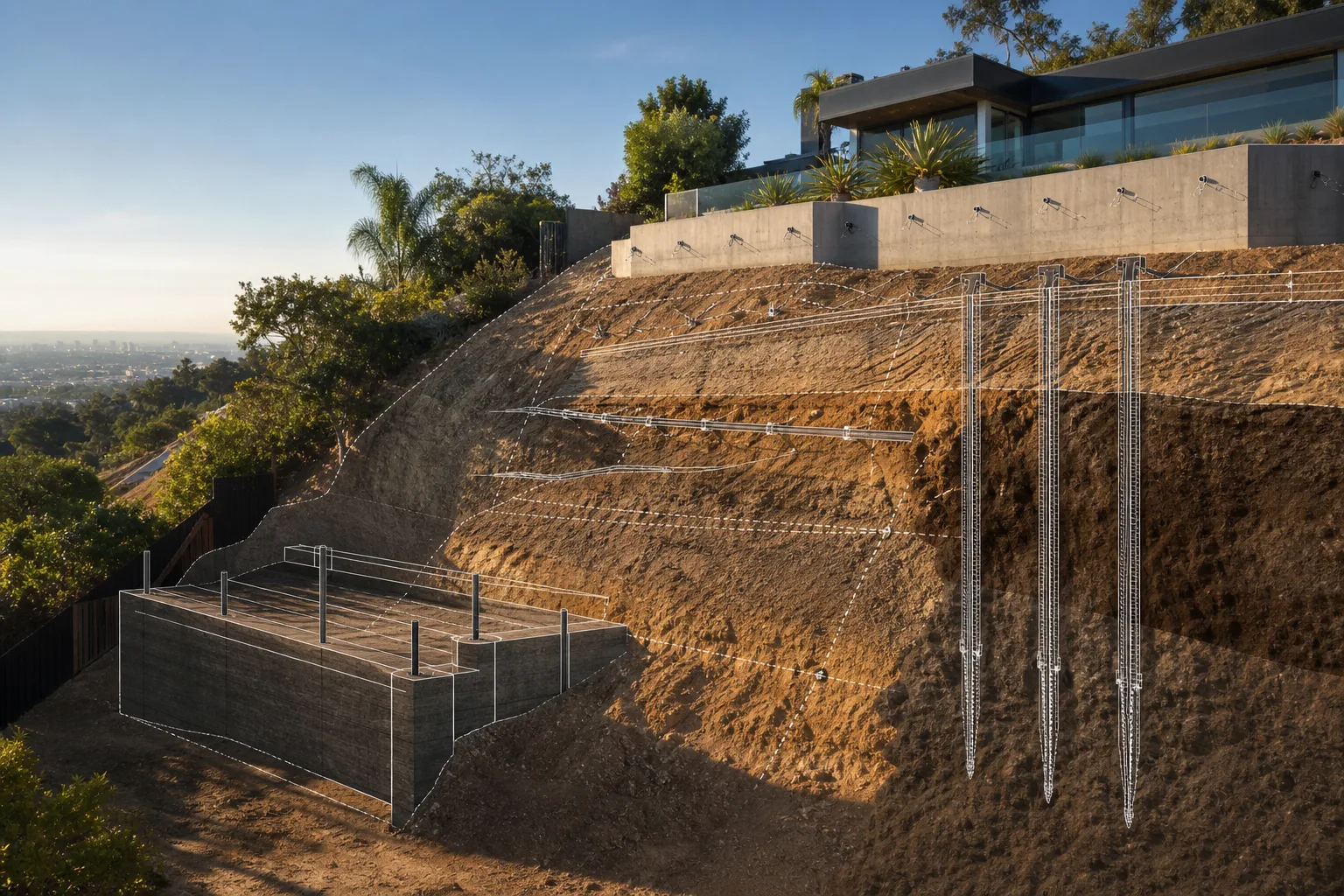
Depending on the site, the project team may consider soil nail walls, soldier piles, tiebacks, retaining walls, underpinning, micropiles, drainage coordination, or other stabilization approaches. The right system depends on the geotechnical recommendations, geometry, loads, access, sequencing, and permitting context.
What to gather before the first call
- Site address and photos from above and below the slope
- Survey or topographic information
- Geotechnical report and any slope stability recommendations
- Architectural and structural drawings
- Photos of retaining walls, cracks, drainage paths, and neighboring structures
- Any plan check comments or correction notices
Project examples
See how these issues show up on real Cefali project profiles.
Priority specialty project for slope stabilization and hillside support positioning.
Specialty Foundations and StabilizationVista Monterey Soil NailsStrong proof point for soil nails, soldier pile wall transitions, property-line limits, and retaining/stabilization work.
EducationGlendale Community CollegeEducation-sector example involving hillside terracing, permanent shoring, and drilled-pile foundation excavation.
Next Step
Send the basics before the project gets expensive.
If you have drawings, a geotechnical report, site photos, plan check comments, or a rough excavation or foundation question, Cefali & Associates can help identify the right structural engineering support.
Send project information