
Quick guide
Is this article relevant to you?
What is this?
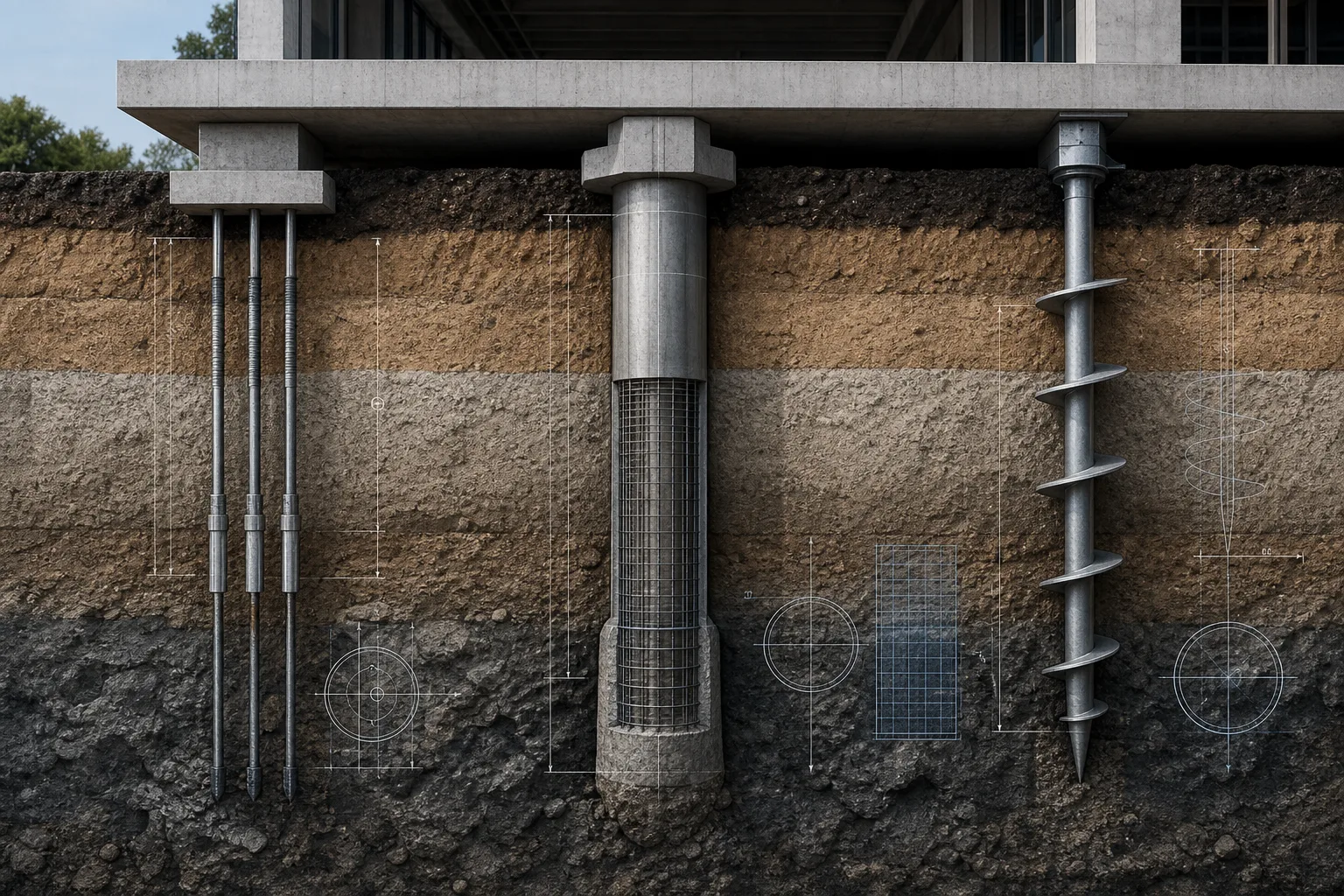
A practical comparison of micropiles, caissons, and helical piles for limited-access and specialty foundation projects.
Who is this best for?
Owners, architects, developers, contractors, and design teams comparing deep foundation options for constrained, retrofit, or specialty foundation work.
This is relevant if you:
- Need deep foundation support but are unsure which system fits the site.
- Have limited access, low overhead clearance, nearby structures, or vibration concerns.
- Are comparing foundation options before design, pricing, or contractor selection.
Key takeaways
- Micropiles are often useful where access is limited, existing buildings are nearby, or conventional equipment is difficult to use.
- Caissons can be a strong option for larger drilled foundations where access and subsurface conditions support them.
- Helical piles may fit certain lighter-load or retrofit situations, depending on soils, loads, and acceptance by the project team.
- The geotechnical report, load demands, and construction access usually drive the shortlist.
Micropiles, caissons, and helical piles are all deep foundation options, but they solve different problems. The right system depends on loads, soils, access, vibration tolerance, equipment, existing structures, and the contractor means available for the site.
This guide is not a substitute for project-specific engineering. It is a practical starting point for owners, architects, developers, and contractors trying to understand which questions to ask before selecting a foundation approach.
What to send an engineer
- Plans, sketches, or existing drawings
- Geotechnical report or soils information
- Site photos, access limits, and adjacent constraints
- Timeline, bid deadline, or current field issue
Where micropiles tend to shine
Micropiles are small-diameter deep foundation elements that can be installed with relatively compact equipment compared with some conventional drilled foundation systems. They can be useful for existing buildings, underpinning, retrofit work, constrained sites, and difficult access conditions.
They are often considered when the project needs deep support but site access, overhead clearance, adjacent structures, or existing construction makes larger equipment hard to use.
Where caissons may make sense
Caissons, or drilled shafts, can support significant loads and are common on many structural and retaining applications. They may be practical when the site can accommodate drilling equipment, spoils handling, inspection access, and the required shaft size and depth.
The feasibility depends heavily on subsurface conditions, groundwater, diameter, depth, constructability, and project requirements.
Where helical piles may be considered
Helical piles can be useful in some lighter-load, retrofit, or limited-disturbance conditions. They are not automatically interchangeable with micropiles or caissons. Capacity, installation torque, corrosion considerations, soils, code requirements, and acceptance by the design and permitting team all matter.
How to compare foundation options
- Available geotechnical information and groundwater conditions
- Column, wall, uplift, and lateral load requirements
- Existing building conditions and underpinning needs
- Access, overhead clearance, noise, vibration, and spoils handling
- Schedule, inspection requirements, and contractor availability
- How the foundation system interfaces with shoring, retaining walls, or slope stabilization
Project examples
See how these issues show up on real Cefali project profiles.
Priority proof point for micropile and specialty foundation engineering.
AviationLAX - Multiple ProjectsIncludes references to micropiles, underpinning, approach pits, building shoring, and support of excavation work.
Private Development755 FigGood adjacent proof point because the project involved underpinning and difficult excavation/foundation interfaces.
Next Step
Send the basics before the project gets expensive.
If you have drawings, a geotechnical report, site photos, plan check comments, or a rough excavation or foundation question, Cefali & Associates can help identify the right structural engineering support.
Send project information